Book Review: Ultralearning: Master Hard Skills, Outsmart the Competition, and Accelerate Your Career
[caption id=”attachment_749” align=”alignnone” width=”353”]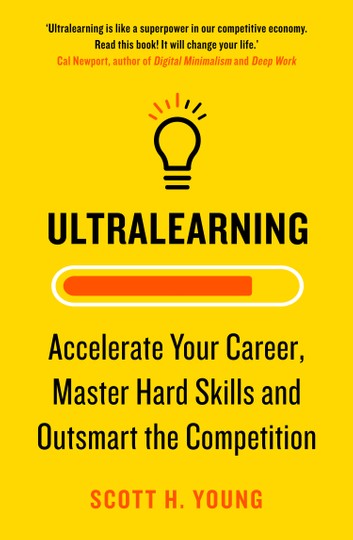 Retrieved From: https://kbimages1-a.akamaihd.net/7c8758dd-f9cc-4506-b23a-d8584e9d0af2/353/569/90/False/ultralearning-accelerate-your-career-master-hard-skills-and-outsmart-the-competition.jpg[/caption]
Brief Introduction: This book is organized into 9 principles: metalearning, focus, directness, drill, retrieval, feedback, retention, intuition and experimentation. The main idea is to master hard skills quickly without old routines and ways of solving problems. These self-education tools are based on author’s real experience combining other ultralearner’s tips.
Thoughts: The 9 techniques are described with clear explanations and examples, facilitating me to directly use them for learning new skills. Although these tools are seemed like cliche, they are quite useful especially for learning some subjects. For me, I think that the “directness” skill is the most useful for me because as a new programmer, I feel a little bit confused about how to apply coding skills into real product. This technique helps me to focus on the final result that I want to acquire by doing exactly what is required in my final project. No more sideway or redundant preparation would be done so that detouring would not apply, representing that I am practicing the “must have” skills for actual product. In addition, while studying for the final exam, I use the recall method to review the topics that are mentioned in the past exam. Therefore, I study efficiently and gain good mark in this exam. In conclusion, trying new learning methods and finding the most suitable habits to reach goals are two key concepts learned in this book. I will keep using these principles to examine that whether successful learning habits are still useful to counter different challenges.
Quotes:
- Project plan: Do the research (what topic and its scope, primary resources used, how others have successfully learned this skill, direct practice activities, backup materials and drills) -- Schedule time -- Execute the plan: nine methods -- Review the results -- Choose to maintain or master that you have learned: maintenance, relearning and mastery.
- Your deepest moments of happiness don’t come from easy things; they come from realizing your potential and overcoming your own limiting beliefs about yourself.
- Technology exaggerates both the vices and the virtues of humanity.
- Ultralearners are those who blend the practical reasons for learning a skill with an inspiration that comes from something that excites them.
- The most captivating stories usually involve heroic schedules. However, the core of the ultralearning strategy is intensity and a willingness to prioritize effectiveness.
9 principles:
- Metalearning: draw a map (Divided into why?what?how?) Why: instrumental or intrinsic motivations? the expert interview method: 15 minutes for answering simple questions (instrumental preferred). What: three column concepts (understand), facts (memorize) and procedures (practice). How: benchmarking (find a syllabus or default curriculum) and the emphasize or exclude method (modification to align with your goals). General: 10% research time for short term project (6 months/100 hours total), 5% for long term (500-1000 hours). Be aware of diminishing returns and marginal benefit calculation!
- Focus: sharpen your knife Struggles with focus in 3 varieties: starting, sustaining and optimizing the quality of one’s focus. Starting: how to deal with procrastination? Recognize WHEN you are procrastinating-resist to the impulse through crutches (5 minutes rule to pomodoro technique: 25 focus with 5 break to chunked hours on calendar). Sustaining: flow doesn’t matter; 50-60 minutes for learning tasks.
- Distraction sources: environment, task and mind Directness: go straight ahead! Directly learning the thing we want feels too uncomfortable, boring or frustrating, so we settle for some book, lecture or app, hoping it will eventually make us better at the real thing. 4 tactics: project-based learning, immersive learning, the flight simulator method and the overall approach.
- Drill: attack your weakness point Break apart the skill: practice its elements in isolation. Direct-then-drill approach: practice the skill directly- analyze the direct skill and isolate components-integrate what you have learned by direct practice. Tactics for designing drills (find rate determining steps): time slicing, cognitive components, copycat (copy the unwanted part), magnifying glass method (spend more time on one particular component even though you can’t separate the work) and prerequisite chaining.
- Retrieval: test to learn Concept mapping or passive review perform WORSE than retrieval practice, closing the book and trying to recall as much as possible. Apply forward testing: take the final exam before the class begins. How to practice retrieval: flash cards, free recall, the question-book method, self generated challenges and closed book learning.
- Feedback: don’t dodge the punches We often avoid seeking information about our skill level until we think it will be favorable; Solicit feedback! Three types of feedback: outcome feedback (are you doing it wrong?), informational feedback (what are you doing wrong?) and corrective feedback (how can you fix what you’re doing wrong?) Faster feedback: better. Improve feedback quality: noise cancellation, hitting the difficulty sweet spot, metafeedback, high intensity and rapid feedback.
- Retention: don’t fill a leaky bucket 4 memory mechanism: Spacing (repeat to remember): space repetition systems. Proceduralization (automatic will endure): heuristic. Overlearning (practice beyond perfect): additional practice or advanced or core practice. Mnemonics (a picture retains a thousand words): Hyperspecific for patterns of information or translate abstract information into pictures or maps, keyword method.
- Intuition: dig deep before building up How to build intuition: Don’t give up on hard problems easily Prove things to understand them Always start with a concrete example Don’t fool yourself
- Experimentation: explore outside your comfort zone Three types of experimentation: learning resources, technique and style—try to learn aggressively and rigorously for a predetermined period of time and then evaluate the approach. How to experiment? Copy then create Compare methods side by side Introduce new constraints Find your superpower in the hybrid of unrelated skills Explore the extremes
All the above sentences are extracted from “Scott H. Young. Ultralearning: Master Hard Skills, Outsmart the Competition, and Accelerate Your Career, HarperBusiness, 2019.” For non-commercial and non-profit use.