Book Review: The new manager's tool kit: 21 things you need to know to hit the ground running
[caption id=”attachment_743” align=”alignnone” width=”334”] Retrieved From: https://images-na.ssl-images-amazon.com/images/I/51cbkMVKZ+L.SX332_BO1,204,203,200.jpg[/caption]
Brief Introduction: This book is organized into 6 parts: leading people, different strokes, leader effectiveness, optimizing contributions, personal and interpersonal effectiveness, and eliminating conflict. It provides all skills and concepts for novice managers to tackle challenges of management and leverage managers’ new position to help the organization succeed.
Thoughts: This guidebook provides me with lessons in the managers’ view to help to increase productivity, work with different personalities of people, communicate effectively, diagnose and deal with problems related to good and problematic employees, encourage teamwork, avoid burnout and eliminate conflicts. From the book, I learned that one the most important skills to retain employees is to make them feel energized, fulfilled and excited about the job or the project, reaching the flow when they couldn’t wait to get out of bed and get to work. Most of the employee have a time feeling frustrated, bored, or dispirited about the job, as well as forcing themselves out of bed to go to work. To avoid the aforementioned situation, the manager should put on the fellow-human-being hat when listening to employees’ work and life concerns, offering essential facilitation to them. In addition, stress factors, such as long hours and job pressures, exhaust us and drain our emotional reserves. We need to relieve those factors so that high productivity could be maintained. Most of the provided solutions in this book are based on psychological research, the core is all about sympathy, making them feel like home and warm. However, when employees behave unexpected, several tools are used to help them ameliorate their bad performance. In sum, management skills and leadership tactics could be cultivated and practiced. Through this book, I think that I gain basic knowledge to overcome tough leadership challenges, resulting in smoothly leading others in a group and further advancement.
Quotes:
- Leadership requires: a. Having a clear and consistent vision and mission (i.e., the chosen direction), communicated effectively. b. Guiding people toward the vision, to be effective in accomplishing the mission. Influencing people to willingly follow that direction.
- Employees want to be appreciated, involved and sympathetic helped on personal problems (Sensitivity to work/life issues) instead of being simply offered good wages, job security and promotion opportunities.
- GRIMME’S TOP TEN TIPS TO MOTIVATE AND RETAIN TALENTED EMPLOYEES a. Pay employees fairly (Equity Theory: own's outcome/own's inputs = other's outcome/other's inputs) and well; then get them to forget about money. b. Treat each and every employee with respect. Show that you care about each employee as a person , not just as a worker. c. Praise accomplishments and attempts: the most effective appreciation practices are specific, personalized, and based on actual performance. d. Clearly communicate goals, responsibilities, and expectations. Never criticize in public: redirect in private. e. Recognize performance appropriately and consistently: Employee of the Month awards were not that effective. However, having the employees themselves determine the results gets them involved, and it minimizes their resentment of the award recipients. f. Involve employees in plans and decisions, especially those that affect them. Solicit employees’ ideas and opinions. Encourage initiative . g. Create opportunities for employees to learn and grow. Link the goals of the organization with the goals of each individual in it. h. Actively listen to employees’ concerns: both work-related and personal. i. Share information: promptly, openly, and clearly. Tell the truth with compassion. j. Celebrate successes and milestones reached: both organizational and personal. Create an organizational culture that is open, trusting, and fun .
- Constructive feedback clarifies expectations and provides information.
- Beef up workplace support to ameliorate the negative impact of job demands on productivity.
- FIVE TIPS TO AMELIORATE JOB DEMANDS AND IMPROVE JOB QUALITY a. Make work more meaningful by applying your organization’s core competencies in creative ways. b. Effectively communicate the mission and vision of your organization: what extent employees' actions are contributing to the fulfillment of the mission. c. Link the mission and the job to the talents and aspirations of each employee. d. Ensure that all employees have sufficient autonomy to deal with the challenges they face in their jobs. e. Reciprocate for the greater demands you place on employees.
- Vision is a loftier and reach-out version of the mission statement, the ideal toward which your organization aspires.
- Provide supervisory support for employees’ work/life issues.
- FIVE PRINCIPLES FOR BALANCING WORK AND LIFE a. Really care about the effects that work demands have on your employees’ personal and family life. b. Never show favoritism when responding to employees’ personal needs. c. Bend over backward to accommodate employees when they have personal or family business to take care of. d. Demonstrate understanding when employees talk about personal or family issues that affect their work. e. Ensure that employees feel comfortable bringing up family or personal issues with you as their supervisor.
- Two of the most significant differences among individuals are ability and personality.
- Understand the true nature of the American workforce and the true meaning of diversity, representing that diversity is not a social problem to be solved, but a business opportunity to be optimized.
- FOUR QUESTIONS TO BREAK DOWN STEREOTYPES a. Does your opinion hold true for everyone in the group? b. Is the person thought of as part of a group first, rather than as an individual? c. Do your past experiences with members of this group affect this interaction? d. Does your opinion reflect the knowledge, skills and abilities necessary to do the job ?
- FOUR CORE CONCEPTS FOR APPROPRIATE LANGUAGE a. Focus on ability. b. Challenge assumptions, prejudgment, and fear. c. Focus on what is to be done, not how or when. d. Challenge tradition.
- TEN Commandments of Communicating with People with Disabilities a. Speak directly to the person, rather than through an interpreter. b. Always identify yourself and others with you when meeting someone who is blind. c. If you offer assistance, wait until the offer is accepted. Listen, wait, or ask for instructions. d. Treat adults as adults . e. Do not lean against or hang on someone’s wheelchair or cart. They treat their chair as extensions of their bodies. f. Listen attentively when talking with people who have difficulty speaking and wait for them to finish. g. Place yourself at eye level when speaking with someone in a wheelchair or on crutches. h. Tap a person who’s deaf on the shoulder or wave your hand to get his or her attention. i. Relax, don’t be embarrassed if you use common expressions that seem to relate to a person’s disability. j. Always offer to shake hands when introduced. Adapted from many sources as a public service by United Cerebral Palsy Associates, Inc. (UCPA) and by Irene M. Ward & Associates (Columbus, Ohio). Copyright 1994, Irene M. Ward & Associates.
- Feedback is a continuous and interactive process, best given as close to the time of the behavior as possible, that is simply information given to and received by people regarding their behavior, not character.
- THREE STEPS FOR POSITIVE FEEDBACK (PRAISE) a. Start by describing the behavior (not the person) using specific language and examples. b. Describe the impact of the behavior. c. Show appreciation for the person’s effort, simple as saying “Thanks!” e.g. I appreciate your working late last night to finish the XXX project. --> behavior. You helped us to meet our deadline and that helps keep our customers satisfied. --> impact (short-term and broader context). Thanks for the extra effort. --> appreciation. RESULT: Use positive feedback to reinforce appropriate, productive, desirable behavior and to show appreciation.
- Constructive feedback is not criticizing or reprimanding, instead, it clarifies expectations, provides information and when done correctly without criticism.
- FIVE STEPS FOR CONSTRUCTIVE FEEDBACK a. Describe the specific, observable behavior using facts. b. Avoid judgments and evaluations by describing the behavior, not the person. c. Describe the impact of the behavior, why you are bringing it to the employee’s attention. d. Check for the individual’s understanding of your feedback and ask for input, inquiry. e. Suggest an alternative by describing the desired behavior, your expectation. e.g. When you return 15 minutes late from lunch. --> behavior. Others have to cover your job. --> impact. Do you see why we need you back on time? --> inquiry. What needs to happen to make that possible? --> expectation. I’d like you to be back at your workstation at 1:00, ready to go. --> inquiry. RESULT: Use constructive feedback to discourage inappropriate, unproductive, undesirable behaviors and to guide the individual toward effective behaviors.
- The Sandwich Technique: Positive feedback -- Constructive feedback -- More positive feedback.
- The focus of assertion is your wants and needs. In contrast, the focus of feedback is the other person’s behavior.
- Use inquiry to confirm understanding, get input and build commitment.
- SIX ELEMENTS OF ACTIVE LISTENING a. Stop what you are doing and give the person your full attention. b. Use silence and do not complete the other person’s sentences. c. Collect the facts on the issue at hand. d. Go deeper: Listen to what is really being said. What does the person want you to understand? e. Use reflective questioning: paraphrase or restate comments to get confirmation: “Let me see if I understand you. Are you saying…?” “You want…Is that right?”. f. Ask clarifying and open-ended questions to inquire: “Give me an example.” “What would you like to see happen?” “Anything else?” “Tell me more.”
- The true cause of most performance problems has nothing to do with an employee’s character.
- FIVE ROOT CAUSES OF PERFORMANCE PROBLEMS a. Expectations: Does the employee know what is expected? Does the employee even know there is a problem? b. Training and Ability: Does the employee have the requisite skills, abilities, and aptitudes to perform the task? c. Job Design: Does the employee have the necessary tools and resources to perform the task? d. Work Environment: This refers not only to the physical environment, but also to how employees are treated. e. Personal or Motivational Problem: Does a problem exist in the employee’s personal life that may contribute to poor performance?
- FOUR STEPS OF A COACHING OR MENTORING DIALOGUE a. Set the purpose of the meeting. b. Gather and clarify information to define the situation. c. Identify and develop ideas to address the situation. d. Determine an action plan.
- FOUR TIPS FOR PERFORMANCE PROBLEM COACHING a. Address problems early (Nip them in the bud). b. Be a problem-solving ally , not an adversary. c. Involve the employee as much as possible in the process. d. If the problem persists, document your actions, keep your manager informed and work with your HR department to take further action.
- Teams do not work for two reasons: They’re not supported or encouraged by the surrounding organization and are not recognized or rewarded for their efforts. They’re not really teams, but merely groups (at best) or pseudoteams (at worst).
- Brainstorm to generate ideas and potential solutions to reach consensus.
- Acknowledge how burned-out you are: Burnout, indicating that inner resources are inadequate to cope with situations, is a form of excessive stress or our reaction to ongoing stress.
- Four Cool Tips for Burnout a. Physical: physical exam -- eat healthy -- exercise -- practice relaxation (purifying breathe) b. Mental: develop or improve coping skills (Serenity to accept the things I cannot change, Courage to change the things I can and the Wisdom to know the difference) -- understand your strengths and weaknesses -- learn effective but inner resource management -- set realistic goals -- learn to schedule “me time” -- consult your Employee Assistance Program (EAP), a life-skills coach or mental health counselor c. Interpersonal: nurture close relationships -- participate in clubs, associations and group activities that relax and enrich you -- address ongoing issues with supervisor, coworkers, family and friends, listening their needs -- consider a job, career or life change in a logical and rational situation d. Spiritual: religion -- arts -- hobbies -- volunteer work
- Stress is what we do to ourselves. All external event stressors that seem like stress really are just triggers of our own erroneous thoughts. Those thoughts are self-conflicting and some variation on “I must and I can’t.”
- THREE DIFFERENT ATTITUDES a. spectators with Neutral: watch life happen and observe others b. critics with Negative: comment on life and complain c. players with Positive: actively participate in life and embrace opportunities
- No one can make you feel anything without your permission.
- FOUR STEPS TO CHANGE YOUR SELF-TALK a. recognize: start paying attention to your internal dialogue, especially when feeling disappointed or frustrated b. stop: tell yourself stop or words and images to that effect c. restate: reframe the negative statement into a positive and more accurate one. d. reward: take yourself on a shopping spree
- SIX TIPS FOR A MORE POSITIVE ATTITUDE a. stay in the present tense b. talk to yourself in a calming and compassionate manner c. talk yourself out of unreasonable expectations and fearful thoughts d. surround yourself with positive people e. do not “should” on yourself f. take action
- Assertion, taking responsibility for solving interpersonal problems through straightforward action and communication, is speaking honestly about your thoughts, feelings and desires, while considering those of others. This is what I think, feel or want and at least implicitly how about you?
- TEN WAYS TO DEAL WITH DIFFICULT PEOPLE a. reframe difficult person into challenging situation to be solved by both parties b. take a deep breath c. allow the other person to express needs, complaints and so on d. utilize active listening and assertion e. turn statements into questions f. be willing to lose the battle in order to win the war g. think about the desired goal h. recognize that old tapes begin to play in our heads i. do not personalize it j. be solution-driven, rather than right-driven
- FIVE RULES OF ANGER a. acknowledge: anger inventory worksheet b. experience: behavioral, emotional, mental and physical dimensions (describe symptoms in words or phrases) c. process: defuse anger by breathing, visualization, self-talk and trying other thoughts or actions that have calmed you in the past, talk about your feelings or choose a constructive means to purge your tension d. express: whenever feasible e. let go
- FEAR FACTOR: justify present behavior, self-pity, procrastination, negative or skeptical attitude, over-analyzing and intellectualizing
- SIX STEPS FOR DEALING WITH CHANGE a. recognize that change involves loss b. accept or reject the change c. approach change as a process: shock -- anger -- rejection -- acceptance -- hope d. develop a positive outlook: recognize -- stop -- restate -- reward (“This is impossible. I’ll never be able to do this!” -- “Stop that! That’s not true.” -- “This is hard; I’m not sure yet how or when I’ll succeed, but I will!” -- “I just changed a negative into a positive.”) e. make a plan: translate positive attitude into a positive plan of action, including short-term goals, timetables, regularly review and revision as appropriate f. allow yourself to be flexible
- Harassment is aggression against another person’s body or mind.
- Address all forms of workplace harassment.
- FOUR TIPS TO RESPOND TO HARASSMENT a. assert yourself verbally b. navy’s traffic light approach: red light (stop: offensive), yellow light (caution: borderline), green light (go: comfortable) c. express yourself nonverbally d. say or do nothing, but report it immediately afterward
- SIX PRINCIPLES TO DEFUSE A HOSTILE COWORKER OR CUSTOMER a. understand the mindset of the hostile person b. avoid confrontation c. allow a total airing of the grievance without comment d. active listening e. allow the aggrieved party to suggest a solution f. move toward a win-win resolution
- SIX PRINCIPLES TO COPE WITH SOMEONE THREATENING YOU WITH A WEAPON a. quietly signal for help b. keep your cool; don’t aggravate his rage c. stall for time and personalize d. negotiate e. respect the weapon, but focus on the person holding it f. look for opportunities for getting yourself and others to safety
- TEN STEPS TO MANAGE WORKPLACE VIOLENCE a. assemble a crisis management team b. create a crisis management plan c. establish a violence-protection policy d. train managers and employees e. use proper employee-selection techniques f. standardize discipline and termination procedures g. recognize signs of trouble and ensure they are reported h. investigate all threats, complaints and red flags i. take appropriate action j. deal with the aftermath
Supplement
[caption id=”attachment_737” align=”aligncenter” width=”578”]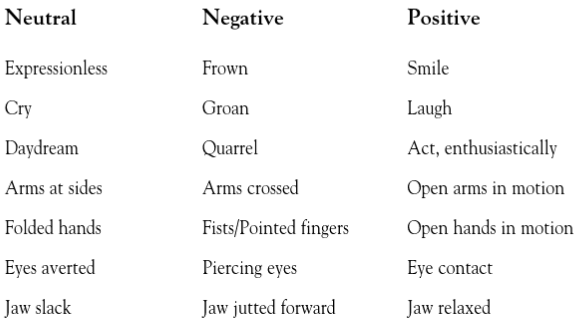 Attitudes[/caption]
All the above sentences are extracted from “GRIMME, Don, and Sheryl GRIMME. The New Manager’s Tool Kit : 21 Things You Need to Know to Hit the Ground Running, AMACOM, 2008. ProQuest Ebook Central” electronic book. For non-commercial and non-profit use.